Understanding Bone Transport
Bone transport involves the gradual movement of an osteotomized bone segment over time to bridge a skeletal defect. This technique plays a critical role in bone reconstruction, particularly when traditional methods either fall short or pose excessive risks to the patient. The principal advantage of bone transport is its ability to generate new bone through mechanical stress, facilitating natural healing while minimizing soft tissue trauma. This process hinges on the principle of distraction osteogenesis, where bone regeneration occurs in response to the gradual stretching of the bone’s periosteum.
Causes of Humeral Bone Defects
Humeral bone defects often arise from a myriad of factors, including post-traumatic osteomyelitis, significant fractures, and failed internal fixation. Similarly, bone defects in the lower extremities can result from trauma, infection, or surgical interventions. These conditions present considerable challenges in surgical management, necessitating innovative approaches like bone transport to effectively restore function and structure.
The particularity of humeral reconstruction
The humerus presents unique considerations for bone transport compared to lower limb applications. Unlike weight-bearing bones, the humerus does not benefit from axial loading during the consolidation phase, which may affect the quality of regenerate bone. Additionally, the proximity of neurovascular structures, particularly the radial nerve, necessitates careful surgical planning and execution. Ammo, the humerus has demonstrated favorable characteristics for distraction osteogenesis, including a higher rate of callus formation compared to the tibia and potentially faster functional recovery.
The anatomical differences between the mid-shaft and distal segments of the humerus contribute to challenges in docking site union. The mid-shaft exhibits a nearly circular cross-section, whereas the distal segment transitions to a flattened triangular shape. During the union, the mismatch in geometry at the docking site results in incomplete alignment of the proximal and distal cross-sections, failing to achieve contact upon
Treatment Options
1.Circular Frames
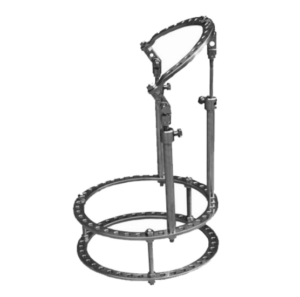
Afzalliklari:
Multi-Planar Stability: Provides robust stability in multiple planes, which is crucial for managing complex fractures and malunions.
Versatility: Suitable for a wide range of bone transport applications, including those involving significant soft tissue compromise.
Adjustability: Allows for precise adjustments during the distraction process, accommodating changes in bone alignment and lengthening.
Ko'rsatmalar:
Complex or multi-fragmentary humeral fractures.
Large bone defects due to trauma, infection, or tumor resection.
Cases requiring multi-directional stability and precise correction of angulation.
2.Monolateral Fixators
Afzalliklari:
Reduced Profile: Less bulky than circular frames, enhancing patient comfort and daily functionality.
Simplicity: Easier and quicker to apply, reducing the surgical time and complexity associated with frame applications.
Patient Compliance: The streamlined design encourages better compliance with treatment protocols due to increased comfort and mobility.
Ko'rsatmalar:
Simple and stable humeral fractures that require external fixation.
Non-weight-bearing bone defects where added stability is needed.
Cases where patient comfort is a priority and the risk of complex complications is lower.
3. Monolateral Fixators Combined with Internal Fixation
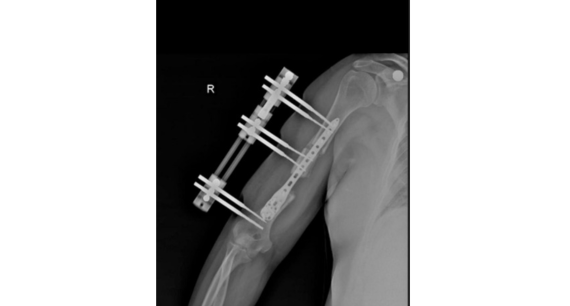
Afzalliklari:
Enhanced Stability: Provides the benefits of both external fixation and internal supports, ensuring more robust stability, particularly in complex cases.
Reduced Treatment Time: May decrease the duration of external fixation, as the internal fixation can support the transport process.
Minimized Soft Tissue Damage: Combination techniques often lead to reduced trauma compared to larger, bulkier fixation systems, thereby resulting in better functional outcomes.
Ko'rsatmalar:
Humeral fractures that are complicated, malaligned, or high risk for nonunion.
Significant defects requiring additional stabilization beyond what external fixation alone can provide.
Cases where early mobilization is critical, and the additional support of internal fixation can enhance recovery.
Postoperative Management
Postoperative care is vital for ensuring successful outcomes in bone transport procedures. Distraction typically commences on the seventh postoperative day, following the latency period suggested by Ilizarov’s method. Initially, the distraction rate is set at 0.25 mm four times daily, totaling 1 kuniga mm. Adjustments are made based on the quality of regenerate bone formation, assessed through weekly radiographs.
Proper pin site care is essential for preventing infections. The most common complications are pin site infections, which can occur in a substantial percentage of cases.Patients are instructed to clean pin sites daily with normal saline and apply chlorhexidine-soaked gauze. Education on recognizing signs of infection and maintaining hygiene is crucial for successful recovery. Furthermore, active and passive range of motion exercises for the affected joints should begin immediately after surgery to prevent stiffness and promote functional recovery.
Follow-Up and Outcome Measures
Regular follow-up is necessary to monitor the healing process, particularly noting the differences in recovery between younger and older patients. Younger patients typically demonstrate faster and more robust bone regeneration, attributed to their higher metabolic rates and the inherent biological capacity for healing. On the contrary, older patients may experience slower regeneration, further complicated by factors such as osteoporosis or comorbidities.
Conclusion
Each of these methods for bone transport in humeral defect reconstruction offers unique advantages and is indicated for different clinical scenarios. The choice of technique should be tailored to the specific needs of the patient, the nature of the fracture or defect, and the desired outcomes for bone healing and functional restoration. Careful consideration of the indications and benefits of each method is essential for optimizing treatment and improving patient outcomes.
Note:The copyright belongs to the original author and the magazine,posts are for learning and communication only.